

Our educational concept is aimed at enabling children to develop holistically by encouraging their natural curiosity and creativity while supporting their need for movement. We follow a situation-oriented approach and place particular emphasis on the key areas of (play), movement and creativity.
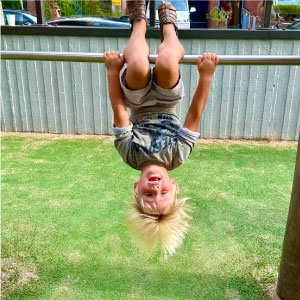
“In a playful way, children explore the world and find out what works, how it works, what can be discovered and how it can be shaped.” G. Hüther
In our kindergarten, free play is an essential part of the educational work and contributes significantly to the holistic development of your children. In free play, children develop important social, emotional, cognitive and motor skills. They learn to express their feelings and to resolve conflicts with other children. By playing with other children, language skills are enhanced and cognitive skills are acquired.
For us, the children’s joy of movement is the focus. We strongly believe that movement is not only essential for physical health, but also supports cognitive and emotional development. When planning and designing our activities, we make sure that we give the children enough space for their individual development and at the same time support them in exploring their own abilities and limits. Our work is based on the principles of autonomy, mutual respect and solidarity, as well as respect for skills and needs. An important part of our movement concept is the integration of Hengstenberg pedagogy, which promotes the children’s holistic development through targeted movement opportunities. Learn more about our movement concept here. Weekly visits to the forest are also on the agenda and, in addition to exercise, provide relaxed experiences in nature.
The creative development of the children is particularly important to us. Music and art are therefore an integral part of our educational programme and accompany the children in their daily lives. Through creative forms of expression such as painting, singing, dancing and arts and crafts, the children have the opportunity to visualise their experiences and to express their feelings. We provide a space for their imagination to flourish and encourage them to develop and implement their own ideas. Our educational specialists support and encourage the children in this process so that they can develop their creative potential to the full.

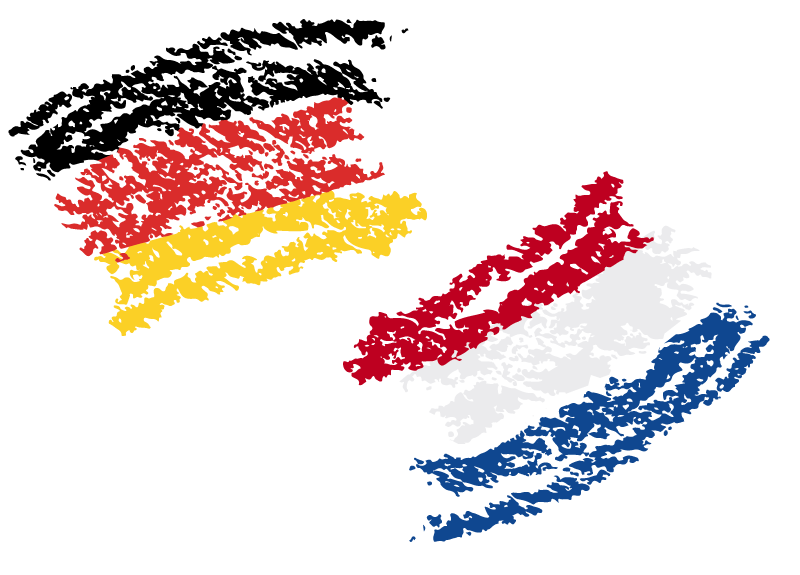
In our kindergarten, diversity is not only accepted, but also celebrated (lived)! We are aware of the importance of multilingualism and intercultural understanding, which is why we attach great importance to providing bilingual care for our children.
In a city like The Hague, which is known for its cultural diversity, we see it as our responsibility to integrate different languages and cultures into our daily lives. Our educators are highly qualified and empathetic, and they are able to provide children with a supportive and stimulating environment in which they can develop their language skills.
German is our first language, and we are proud of giving children the opportunity to learn and master this language from the very beginning. At the same time, we recognise the importance of the local language and enable our children to experience multilingualism on a daily basis by having a Dutch educator on our team. If German is not their first language, we offer the children the opportunity to learn the language as quickly as possible with the help of various concepts.
Our aim is not only to give children the language skills they need to navigate a globalised world, but also to develop a deep understanding of different cultures and ways of life. In our kindergarten, diversity is not only accepted, but seen as an enrichment to be celebrated.